Adobe’s dominance in software for creative professionals and its move to subscription-based services have led to a steady increase in the stock price over the past decade. The stock may have been volatile in recent months, but the long-term math is still impressive.
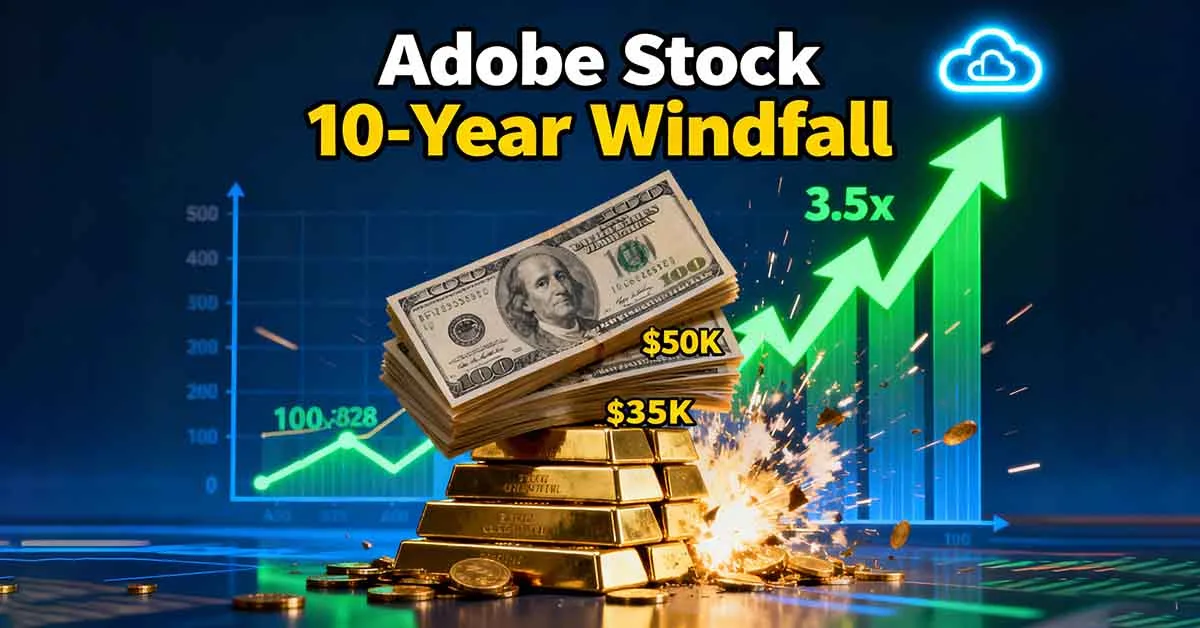
Using long-term data on performance, Adobe’s stock has a 10-year return of 252% (price alone, without dividends). This is through November 2025. This means that a $10,000 hypothetical investment in Adobe stock made around November 2015 is worth approximately $35,200, or more than 3.5 times your original capital.
Breaking down the 10-Year Return
Adobe doesn’t offer a dividend. So, the return on investment has been largely due to price appreciation. Earnings and valuations have increased. Adobe stock compounded in the mid-to-low teens at an annualized pace over the past decade despite steep declines in 2022-2024 due to deflated software multiples.
Here’s an overview of what happened to the $10K in 10 years using 252.38% as a guide.
- Investment (late 2015): Initial investment of $10,000
- 10 Year Total Return: 252% (Price Only)
- Estimated final value
- 10,000x(1+2.5238)35,23810,000x(1+2.5238)35,238 – rounded to about $35,200
Adobe hasn’t distributed any cash to its shareholders. Investors who have held the stock through all of its ups and downs, however, are reaping the benefits from compounding.
Why Adobe Stock Could Deliver That Growth
Adobe’s transformation of boxed software into cloud subscriptions (Creative Clouds, Document Clouds, Experience Clouds) is at the core of this story. Strong margins and recurring revenue have helped to push the 12-month trailing revenue above $23 billion. Net margins are hovering around 30%.
The market has rewarded this shift by rewarding Adobe with a premium price for years. Adobe’s stock average price-to-earnings ratio is over 45. However, it has been compressed recently into the low 20s due to the reset of software multiples. This combination of increased earnings and a higher multiple explains why a “boring” design and PDF company turned a five-figure stake into a mid-five-figure stake in just ten years.
Volatility Check: It Wasn’t a Smooth Ride
Adobe stock’s headline figure makes it look like an upward trend, but there were serious declines along the way that would have shaken weak hands. Adobe stock has experienced a 40% decline in 2022 and another double-digit drop in 2024. This is after a 77% recovery in 2023.
Adobe’s stock is currently trading in the mid-$300s. This is a sharp drop from its 52-week peak of $550, and well below the peak value during the zero-rate era. These swings may have been painful for a long-term investor who bought and held onto the stock a decade earlier, but they didn’t affect the compounding result.
Key Lessons For Long-Term Investors
Adobe’s stock example illustrates how a software company that is focused and generates cash can create wealth beyond the headline index returns. This compounding of wealth occurs over an entire market cycle. The 10-year, 3.5x result from a single company shows what can happen when recurring revenues, pricing power, and disciplined buybacks accumulate over time.
This also shows the importance of time-horizon and temperament. Investors had to endure multiple drawdowns of 30%-40%, valuation compression, and macro-scares to achieve that 252% gain over a decade. If you’re wondering “what would have happened if I bought Adobe stock 10 years ago?” the better question to ask is “which quality compounds am I willing to hold through the next decade of volatility?”