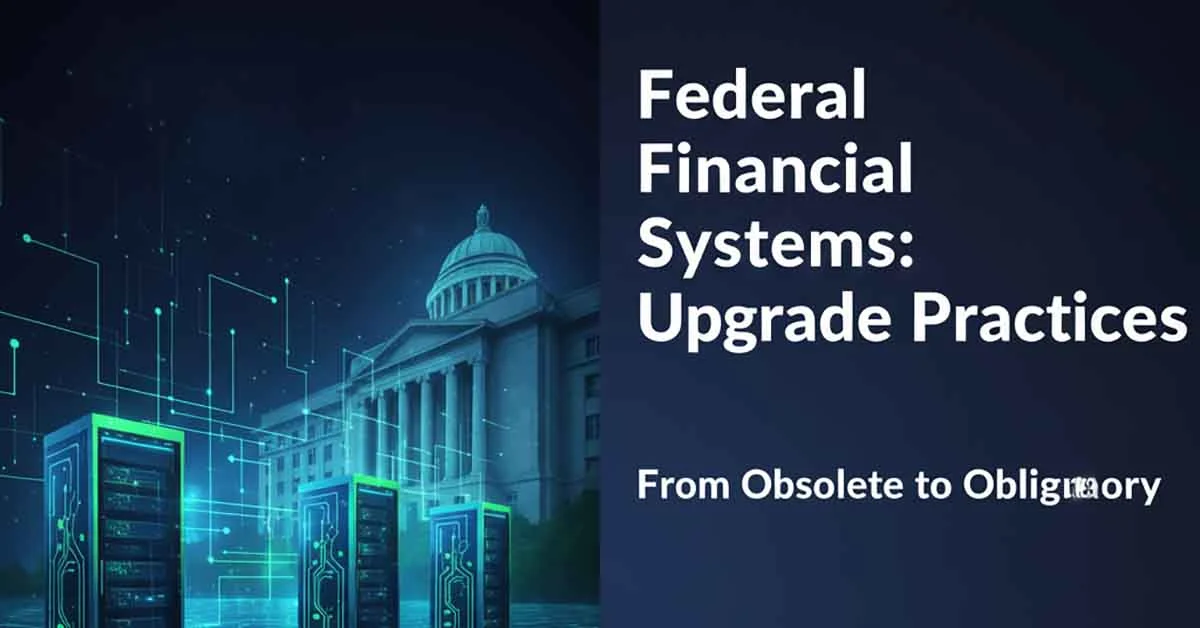
Unfortunately, the phrase “obsolete financial systems” has been used too often in conjunction with “federal” financial systems. In many agencies, outdated technology creates bottlenecks and poses security risks. As the digital age continues to advance, these systems must be upgraded.
Modernizing these systems involves more than just new software. It’s about a fundamental transformation that will bring greater transparency, efficiency, and better management of taxpayer dollars. Such large-scale revamps are complicated. To avoid common pitfalls, a disciplined and strategic approach is required. Here are eight best practices that will guide federal agencies to modernize their financial management from outdated systems.
1. Strategic Planning & Vision Alignment
Before any code is written or a vendor is selected, agencies need to develop a long-term, clear vision. It is important to define specific goals, outline desired outcomes, and map how the new system aligns with the agency’s mission and the broader federal objectives. Replace “old with new”, but replace it with “old with better”.
- Key action: Create a leadership team that is cross-functional and committed to the vision.
2. Engagement of Stakeholders from Day One
Everyone is affected by modernization projects, from budget analysts to purchasing officers. It is important to involve stakeholders as early and often as possible. Their input ensures that the new system is able to meet diverse operational requirements and fosters an ownership sense, reducing later resistance to change.
- Action to take: Hold regular user feedback sessions and workshops.
3. Data Quality & Migration
The quality of the data in a new system will determine its success. Even the most sophisticated platform can be crippled by poor data quality. The agencies must devote significant resources to cleaning, validating, and migrating historic data. Often, this involves archiving older data and creating a clear data governance policy for the future.
- Action to Take: Develop a robust migration strategy, including a testing plan.
4. Embrace Cloud First Solutions
Cloud-based solutions are unmatched in terms of scalability and security. Cloud-first approaches allow agencies to take advantage of modern platforms, reduce the infrastructure burden, and accelerate deployment. This approach not only streamlines operations but also improves data accessibility and disaster recovery capabilities.
- Action to take: Prioritize cloud native or cloud-adapted financial software.
5. Prioritize Security & Compliance
Cyberattacks are a major concern for federal financial systems, which are also subject to strict regulatory requirements. (e.g., FISMA and OMB Circular 123). Security is not an afterthought. It must be incorporated into the entire modernization process from system design to data encryption and access control.
- Action to take: Engage cyber experts early and conduct regular assessments
6. Agile Methodologies & Phased Implementation
Big Bang Implementations are risky. A phased implementation allows agencies to roll out new functionality incrementally, test thoroughly, and collect feedback. This reduces disruption. Agile methodologies that focus on iterative improvement and continuous development are well-suited to these complex projects.
- Action to take: Break the project down into manageable phases, with clear deliverables.
7. Change Management & Robust Training
People need to be able to adapt as technology changes. To ensure that users are able to operate the system effectively, comprehensive training programs are necessary. A proactive change management plan is also important to address employee concerns, communicate the benefits, and guide them through the transition.
- Big Picture: The rapid rate of technological advancement is reflected in the volatility in areas such as AI. Stocks: Why 2026 could be volatile. This shows that systems need to be designed for constant change and not just an upgrade.
- Action to be taken: Develop customized training modules and identify champions of change within the agency.
8. Continuous Improvement & Post-Implementation Review
Modernization is not a one-time thing. After the initial deployment, agencies need to establish processes for ongoing system optimization, performance monitoring, and regular updates. Reviewing the implementation process afterward can help to identify what went well and where refinements are required.
- Action to take: Regularly schedule performance reviews and feedback loops for users.
Upgrading federal financial systems is a monumental undertaking, but by adhering to these best practices, agencies can successfully transition from outdated infrastructures to efficient, transparent, and secure financial management platforms, ultimately serving the public better.
Read more: Explore resources on federal IT modernization from the General Services Administration and their TMF initiatives.
Latest Posts

Elite Personal Finance Reviews — The Ultimate Guide (2026)
In the current financial climate, the right personal finance tool or service will have a huge impact on your financial health. This complete guide to Elite Personal Finance Reviews guides the top financial tools, coaching services, budgeting software, and financial planners that are available within the USA. We discuss real user experiences, in-depth evaluations, important … Read more

OPEC Fund to Co-Finance $2 Billion for Africa’s Development
The OPEC Fund for International Development (OFID) has announced plans to co-finance as much as 2 billion dollars in order to accelerate the development of infrastructure and growth in Africa. This important initiative for development will concentrate on access to energy as well as food security and…