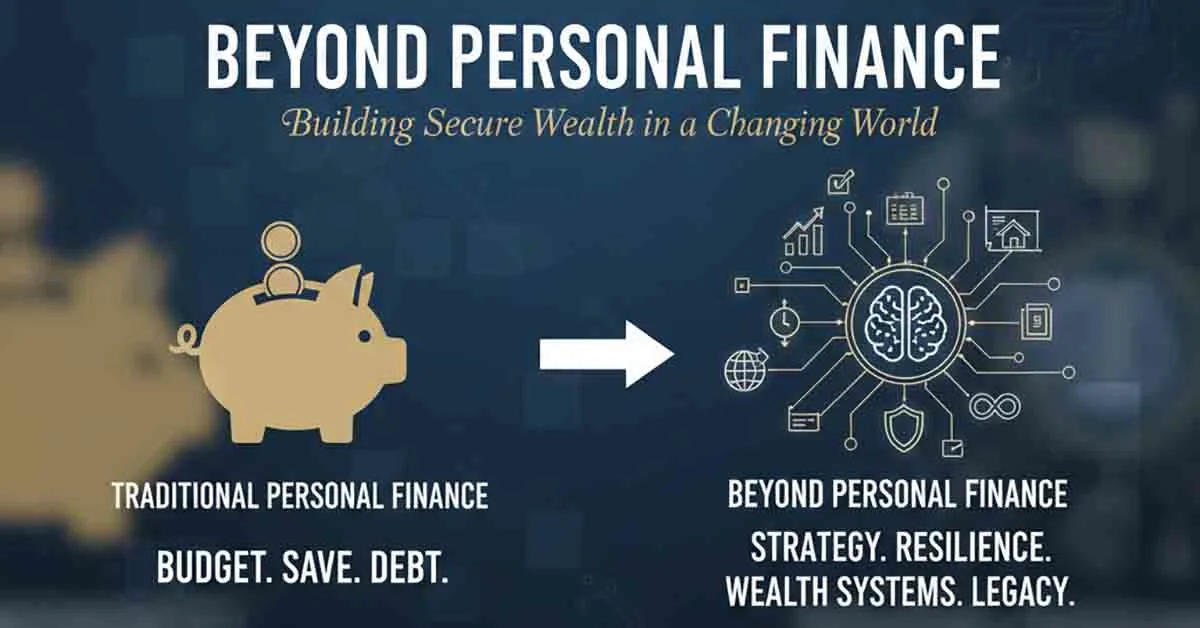
For decades, personal finance advice followed a familiar script. Make your own budget.
Save more.
Avoid debt.
Invest early.
Although these principles are still important, they’re no longer sufficient. The world of finance is changing more rapidly than the majority of people realize. Inflation can deplete savings. Careers tend to be less stable. New asset classes are appearing quickly. Technology is changing the way money is made and invested. It also changes how money is secured.
This transition sets the stage for a broader, more strategic view of financial well-being.
Beyond personal finance is thinking beyond the basics of financial management. It’s about strategy, mental toughness, resilience, and long-term goals. It’s not about being financially secure, but also about creating secure wealth and security that lasts in a changing world.
Traditional advice like budgeting and saving still matters, but as explained in this personal finance guide, modern wealth building requires broader thinking and long-term strategy.
What Does “Beyond Personal Finance” Really Mean?
Traditional personal finance concentrates on directing the money.
Beyond personal finance is controlling money with intent.
In essence, it’s an integrated method of ensuring financial health. It integrates investing, income, psychological, and career growth, risk management, and the legacy plan into a single system.
Instead of asking “How do I budget better?”
It is asking, “How do I design a financial life that supports my goals?”
Instead of chasing expenses for hours, the company focuses on decision-making frameworks.
Instead of seeking quick wins, the company focuses on long-term results.
This is essential in a time when recessions, job losses, or market turmoil are becoming regular.
From Money Management to Wealth Strategy
Financial Systems Matter More Than Financial Habits
The importance of good habits is in the way you live. Consistently saving money and avoiding excessive debt are still important. However, habits alone are not enough to create lasting wealth.
Wealth is generated by utilizing a system.
A financial system includes:
- Automated investment
- Tax-efficient structures
- Asset allocation rules
- Risk controls
- Regular review cycles
If structures are set up, growth is made even when motivation begins to fade. This is among the fundamental ideas behind moving beyond personal finances. You must stop using willpower to make decisions and begin using structures.
Strategic Thinking Over Tactical Budgeting
Budgeting is a tactic. The strategy is directional.
A strategic strategy considers:
- Net worth growth over time
- Return on capital investment
- Cost of opportunity
- Value of time in money
Instead of worrying about tiny expenses, focus on making decisions that move the needle. The choices you make regarding your career, allocation of investments, and ownership of a business are often more important than spending cuts of a minor amount.
Investing Beyond the Basics
Asset Diversification in the Modern Economy
The basic investment advice usually only covers bonds and stocks. Beyond personal finance, it is important to encourage broad thinking.
Modern portfolios may include:
- Global markets for Equities
- Fixed income to ensure stability
- Investment property for income as well as inflation protection
- Alternative assets for diversification
Diversification is no longer a luxury. It’s a method of defense against uncertainty.
True diversification also requires knowing the correlation between liquidity, as well as risk exposure, and not simply holding a variety of assets.
Passive Income and Ownership Models
Earnings from labor have limits. Ownership scales.
The passive income source can be:
- Dividend-paying stocks
- Rental properties
- Licensing and royalties
- Business equity
- Digital products
Beyond personal finance focuses on the distinction between working for money and making money a source of income. The objective is not to avoid working and to decrease dependence on a single source of income.
Career, Skills, and Income Expansion
Income Is the Primary Wealth Engine
A lot of people are focused on saving; however, the growth in income can have a greater impact.
A higher income can:
- Investments that are more efficient
- Greater risk tolerance
- More flexibility in downturns
Beyond personal finance considers the development of your career as a financial plan. The skills, qualifications, and experience are assets. Networking, negotiation, and ongoing learning are examples of investing.
Entrepreneurship and Side Hustles
The modern economy encourages initiative.
Consultancies, side business, freelance work, and digital ventures may:
- Diversify your income
- Develop transferable skills
- Create an option
Every side hustle doesn’t need to turn into a fully-fledged business. Even small extra earnings can help build wealth when they are invested in a wise manner.
The management of risk is crucial. Innovative entrepreneurs try out ideas gradually instead of betting everything in one go.
Psychology, Behavior, and Money Mindset
Emotional Decision-Making in Finance
Decisions about money aren’t always rational. In fact, greed, fear, and social pressure affect the way we behave more than spreadsheets.
Market crashes can trigger the market to panic sell.
Bull markets promote excessive confidence.
Social media encourages competition and a sense of urgency.
Beyond personal finance believes that emotional control can be an advantage in competition. Success in the long run is often based on doing less and not doing more in times of stress.
Financial Identity and Values
Values are reflected in money in a way, whether or not you realize it.
A strong financial reputation can guide choices. It answers questions like:
- What are the uses of money?
- What trade-offs will I be willing to take?
- What does “enough” look like?
When investing and spending align with your personal values, the financial decisions are more logical and less stress-inducing.
Alongside mindset and values, protecting what you build becomes paramount.
It is frequently misunderstood. It’s certainly not an investment. It’s a form of protection.
Beyond personal finance, insurance is viewed as a way to protect the progress made already.
The most important areas are:
- Health insurance is a way to safeguard your income.
- Life insurance for dependents
- Disability insurance to earn power
- Liability insurance can help reduce the risk of catastrophe.
Inattention to protection could ruin years of building wealth within a single instance.
Emergency Planning and Financial Resilience
Resilience is the capacity to withstand shocks without breaking.
Flexible cash reserves and diverse income sources offer a breather during times of stress. They can help you make better choices when pressure is on.
Beyond personal finance, resilience is a priority over optimizing. Being marginally inefficient but adaptable is more often safer than being completely optimized, but fragile.
Legacy, Impact, and Financial Purpose
Estate Planning and Generational Wealth
Wealth planning doesn’t end at the level of an individual.
Estate planning helps ensure you transfer assets on time and in accordance with your intentions. This is the case for trusts, wills, beneficiary designations, wills, and planning for succession.
Beyond personal finances encourages the early development of plans. This is not because of the possibility of death, but because clarity can reduce uncertainty for family members.
Social Impact and Ethical Finance
Money is a factor. It is how it is spent that matters.
Many investors are now thinking about:
- Environmental impact
- Social responsibility
- Corporate Governance
Ethical investing doesn’t mean the loss of profits. It’s about making sure that capital is aligned with the values. Beyond personal finance recognizes that wealth is an instrument to bring about positive change in the world, and not only the comfort of one’s own.
Technology and the Future of Finance
Technology has revolutionized access to financial services and the process of making decisions.
Automation makes saving and investing easier.
Fintech platforms reduce the barriers.
Data improves transparency.
Technology also brings new threats. Complexity, overtrading, as well as false information are all common pitfalls.
Beyond personal finance is a way to encourage the utilization of tools. Technology should aid in the strategy, not replace it.
Understanding how tools function will be more valuable than trying to find the latest trends.
How to Move Beyond Personal Finance Today
Moving beyond personal finances doesn’t require a radical change in a single day. It takes a lot of patience.
Begin at:
- Reviewing your financial goals beyond savings for short-term goals
- Finding opportunities for income growth
- Automating critical financial processes
- Making investments that are diversifying thoughtfully
- Strengthening risk protection
- Personal values: defining the personal values of each person
Avoid common mistakes, such as:
- Overreacting to market volatility
- Copying other people without context
- Acquiring complexity without knowing
- Not paying attention to planning and protection.
The process of progress is based on constant reflection and consistency, and not on perfection.
Conclusion
Personal finance is not solely concerned with managing your money. It’s about defining the life you want to live.
Beyond personal financial planning signifies a shift in focus from survival to strategy. It combines wealth, purpose, as well as resilience, adaptability, and purpose. It acknowledges that financial decisions are closely tied to the persona, career, and long-term perspective. In the midst that is awash in uncertainty, the objective isn’t to be in control.
The goal is preparation, clarity, and direction.
The people who are able to move beyond personal finances do not simply create wealth.
They build confidence in their flexibility, as well as peace of mind.